During my visit home for Easter, I dropped into the creative arts center my mother manages. She wasn't in her office, but I saw she hung a print of Mary Cassatt’s Mother and Daughter over her desk. I went to the ballet room where 20 five-year-old girls in tutus played duck duck goose. I saw my mother bend down, unzip a five-year-old’s pink jacket and lifted her up so she could reach the coat hook. She said “Okay, now go put your shoes in the cubby and find a spot on the floor,” with the same tone she used to use with me. I remembered myself at five, reaching up to pick a honeysuckle blossom off the vine in our back yard. "Pinch the bud," she'd said, "gentle, gentle. If you pull the style through the bottom of the petals you can taste a drop of nectar.”
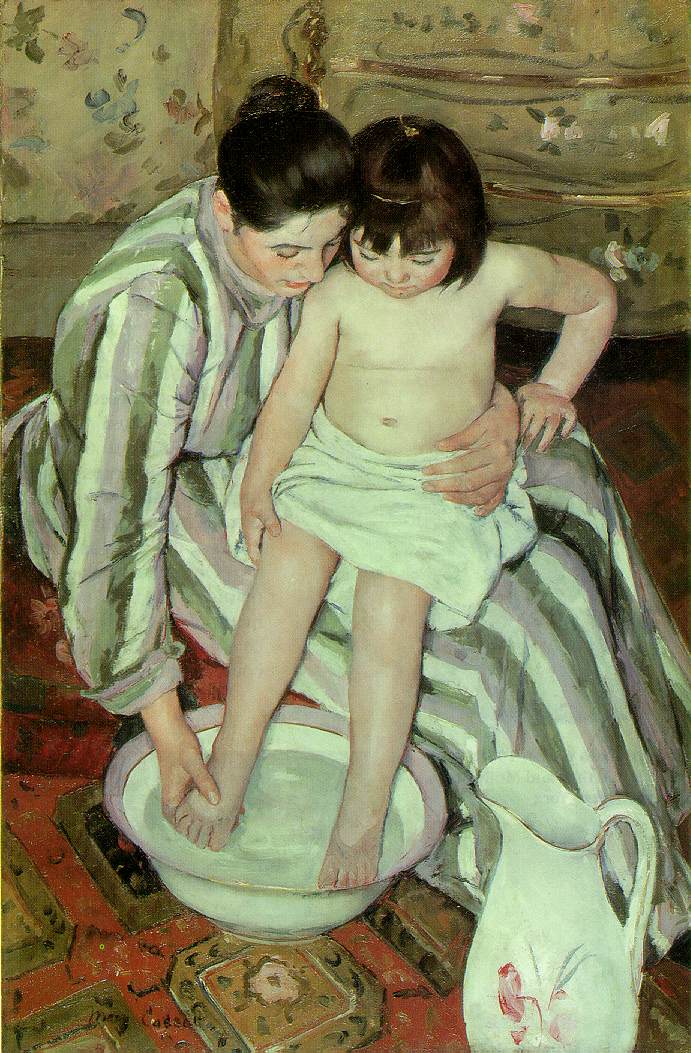
I was raised with my two sisters in a creaky old Midwestern farmhouse, now surrounded by the town that grew up around it. During my sophomore year of high school, Mary Cassatt paintings started showing up around the house. The Bath hung above the bureau full of picture albums. Mom bought a print of The Bath for $5 at a rural library she found while researching her ancestry. Years later, she saw originals at an art gallery, and a photograph of Mary Cassatt. "She looks like your great aunts," she said. "Just like some of our relatives."
In The Bath, a mom holds her daughter on her lap and washes her feet in a wash basin. Cassatt’s an Impressionist, among the ranks of Degas and Renoir, best known for a period where she painted mostly mothers and children in everyday scenes. Like most art, what makes them brilliant is the something else, and here, the something else is the ease of being between these mothers and children. Cassatt communicates a very specific kind of love through the relaxed way a child rests a hand on her mother’s knee, the way a mother holds the child up on her lap with a secure but gentle hold.
I remember my mother taking me out to the garden when I was young to dig my little hands into the dirt while she planted tomatoes. There was no lack of these every day moments, or of love, in our house. When my parents moved me into my first dorm room, she cried and hugged me out the window of the car as they pulled away. “I never even taught you how to make a roast!” she had said. I said, “Its okay, Mom. I haven’t eaten meat in six years.” More recently, when I came home from a year abroad heartbroken and emotionally steamrolled, she sat with me in my old bed, wrapping and unwrapping pieces of my hair around her finger until we both fell asleep.
I suspect that my mother’s love for Cassatt’s work has less to do with her life as a mother than as a child. When my mother was eight, her mother died of a massive brain aneurysm. Grandma was about my age then, 33. Over time, Mom's early memories have blended with stories she's heard or things she may have made up: Her mom trying to curl her hair to look like Shirley Temple’s. Dyeing eggs in a cup of vinegar and food coloring, A fight over an onion.
I returned to Minneapolis after my Easter visit. The ground thawed and tulips popped up as they do. I called my mother to find out how to get candle wax out of my favorite skirt. (Hot iron. Newspaper.) I asked her what the deal is with her Mary Cassatt obsession.
"I dreamt about a painter who was my mother, and the next morning I looked in an art book and saw the painting of the mother bathing the 7 year old girl," she said. "I just cried. Finding that painting did more in healing my childhood than anything has, including being a mother." I had identified with the daughter in the paintings they express a maternal comfort I’d received growing up. My mother loved Cassatt’s work because through the child and mother, she drew out a little bit of the maternal love she had missed.


6 comments:
I love this essay.
What a lovely piece. Thank you.
Really beautiful Cavu. Thank you.
I'm fond of this one too. It started in Deborah's art-writing class.
Great edits from the first draft. Are you going to send it out?
Very, very nice.
Post a Comment